
BY DAN
Hello and welcome to our offseason series. In this we’ll take a look at what is likely to be another challenging year. Sometimes it won’t be fun but occasionally it will, because life sucks and we deserve a little peace and a promise of sunshine. Part I on Ethan Strange is here. Part II on the edge depth is here.Part III on Morgan Smithies’ role is here. Part IV on the risks of manufacturing a hooker is here. Part V on Stick’s recruitment challenges is here.
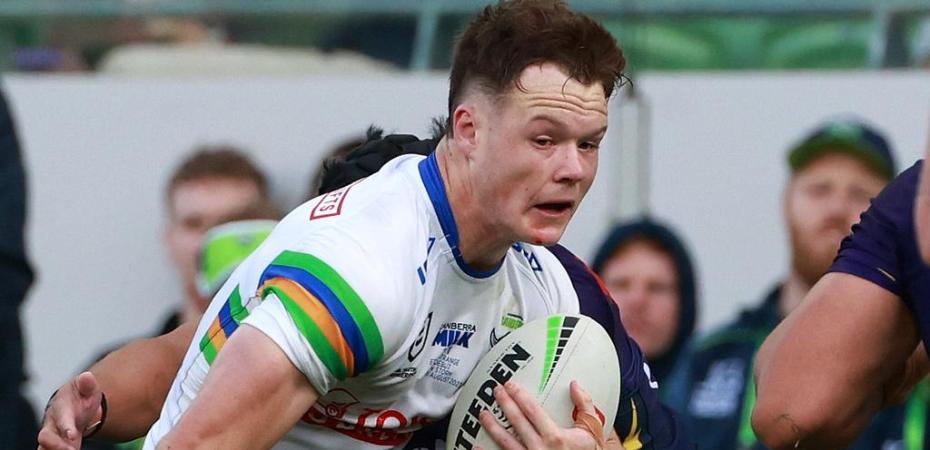
In an attempt to fit multiple moving parts into the one Green Machine there is a chance that Coach Stuart will move Ethan Strange to centre.
It’s a favourite of team-list engineers everywhere. Move Strange to the outside backs. Put Sanders at six. Live the dream. We’ve heard some rumours that Sanders has trained as left-side half in pre-season. Some reports out of the opposed session that occurred before the public last Friday confirmed that.
There is a logic to it. Ethan Sanders is very good. Moving Strange to accommodate him would allow the Raiders to play an extra half. For an offense that has been moribund for the last few years, surely another organising half will help (it didn’t last year, but this one has a new hat). A spare half at left centre is 50 per cent more half. You dig?
As importantly, when they’re theoretically your starting halves for the next Premiership winning Raiders team, there’s a utility to them getting games under their belts, even out of position. There’s even a theory that playing centre will help Strange get better at five-eighth. It worked for Laurie in 1991. It worked for Brad Fittler in 1995. You might even argue it worked for Matt Burton a few years back (eh…sorta).
It’s also a space that Coach Stuart loves. Competition. Some people will tell you when you have ten answers you have none. But Rick wants people fighting for minutes, backups breathing down starters necks, everyone scrapping for a chance to prove they have the juice now.
And he’s proven willing to mess with team lists to accommodate such peccadilloes. Aidan Sezer and Matt Frawley starting at nine. Jack Wighton playing centre outside Fog and Frawls . Seb Kris playing fullback. Sometimes Stick just wants people on the field. Sticky even did this version last year, moving Strange for a game and half as part of his semi-annual ‘flailing for ideas’. It always works (don’t check that). Sure it can work this time too?
Well you might be surprised to hear this but there a substantial risks to this in both the short and long term. Let’s start with the immediate challenges.
Not enough balls
I’m not sold that this is the best approach for Canberra. Indeed it is more a manifestation of the difference between fantasy and reality, with the impact of uncertainty mixed in. If more ball players is the aim, it isn’t a solution. There’s only one ball. Someone always ends up watching.
This has changed since the time of Daley and Fittler. The game has hyper-specialised through the professional era (just as Weber predicted. Big rugby league fan Max). Once having a bunch of talented dudes on the field was enough. Nowadays teams that succeed have people performing specific roles. Attacking certain points of the field, and executing with a precision that comes from perfecting a role. If you’re not one of the main ball-players then your role isn’t ball playing, and you won’t really have a role in it.
Having lots of head chefs and no line cooks on the field doesn’t get you more food, just more points of blame. When Adam Cook played alongside Jamal Fogarty all that happened is that Fog ended up watching the game while Cook did a budget impression of him. Putting Sanders at six has the risk of hampering both Fogarty and Strange. Exciting!
Strange is already good
Moving Strange to centre ignores our evidence so far is that he’s already a burgeoning six. Through twenty rounds at the position in 2024 Strange created nine tries (second in the team behind Jamal Fogarty’s 10). In the five games he didn’t play five-eighth*, his replacement at the position had as many try-assists as me and scored one more try. The attack, impressive through the first six weeks of the season with Strange and Jamal Fogarty sharing the creativity, cratered. Average points went from 25.7 through six weeks to 19.8 by end of season. Through the five games Strange wasn’t in the six jersey they averaged 16 points a game. For a team that has spent the majority of existence trying to find elite halves, to push out out to centre after that as a first offering would be stunning.
Defensive risk
Assuming that Sanders is doing better than a 20 year old half doing that requires a degree of trust in the coaching staff they haven’t earned. That trust quotient only ramps up when you how much Strange has struggled at centre for the club. Through two total games and one part game where he’s played centre, Canberra has conceded 48, 42, and 46 points. In his only ‘woe-to-go’ game at centre in 2024 four tries and six line breaks came down that side of the field.
That’s obviously not all (or even mostly) on him. It reflects what happens when you remove a load-bearing position from the club. Canberra’s defensive success has come from tightening up outside in. That is, using better edge defence to mask the inconsistent defensive prowess of its middle third (something that is only more necessary when Danny Levi plays hooker). In 2019 it came from nowhere through the introduction of Wighton and Bateman on the edges. Later it was Wighton, Young and Whitehead. Now Strange and Young play that role. Hopefully Matty Nicholson can get in the job too. It works because it means there’s one small body in the line to protect. Now there’s two, three if you count Danny Levi.
Like Jack Wighton before him, Ethan Strange has succeeded at six because the decisions are less complex. The physical is more important. Follow your second rower in, pick the right person to hit, get on your bike if you got it wrong. Centres are asked to solve much more complex problems, often with more people opposite you than beside. Moving Strange wider introduces two weaknesses where there once was a strength.
But there are challenges to the long term look of the Milk to. Most notably on the development front.
Development risk
People’s comfrot with moving Strange to centre is largely a recognition that he’d work it out (because he would) and a trust that the experience would prepare him to shift to six later in his career. After all it worked for Loz. Even Wighton (though I’d argue he’s the same player doing the same things regardless of position). But this path is laden with risk, making us trust the club will magically develop people for roles they’re not playing. It essentially stops the clock on him becoming the six he’ll need to be if the Raiders are going to win chips.
If the concern of Strange’s bonafides is that he’s not yet developed a creative game, will that be helped by watching another option learn on the job? Will he get options to work on his creativity when the Raiders outside backs touch the ball less than a eunuch? Think of the last time Canberra consistently got Matt Timoko the ball in space. Think of how often Seb Kris gets to make any substantial ball-play decisions. Putting Strange at centre to watch other people play footy, remaining surplus to the requirements of Sticky’s game plan, seems laden with waste. Canberra may be playing a long game, but a career is not a thing to waste.
Even if Sanders’ introduction brought a more expansive game, in the modern game the roles of centre and five-eighth are so significantly different. Once it was another pass down the line. These days the role of six is significantly more complex in attack. The five-eighth is the fulcrum, the point around which the critical decisions are made on shifts. That decision tree isn’t easy, and a job that requires time and repetitions in the position to learn.
In the end it’s actually just avoiding difficult decisions and hard conversations. If you are that convinced about Ethan Sanders (which, to be fair, I am in that camp making a fire and telling yarns about Michael Dobson) then the argument shouldn’t be Ethan or Ethan, but a far more awkward Sanders or Jamal. Sanders and Fogarty are lead halves, and should be playing as such. Strange is a rock-em sock-em five eighth and should be playing as such. His competition should be Weekes not Sanders.
The investment risk
Canberra have made a bet that Strange is going to their six for a long time. They’re paying him above average half money now on the expectation that he’ll be an elite six by the back end of the deal. Paying them a slightly above average wage for a half before he’s elite is a good approach. A gamble, but a smart one they need to take. That’s the value of the position. If they’re not preparing him for that then they’re wasting their investment. If not, then they’re paying top-of-the-line outside back money. That means that even if Strange becomes elite at the position then there’s no value in the club at the back end of the deal. They’re just overpaying.
For the Canberra Raiders’ youth movement to realise its intention, it needs to make the best of the talent it’s acquired. That means value for money. Surplus value. Not in the way it has for years, by getting marginal gains from mediocrity. But by making sure the big bets they’ve made on Sanders, Stewart, Pattie and Strange pay off. Big time. The Raiders have a foundational piece in the six jersey at the moment, and no amount of overthinking or fantasising will alter the importance of keeping him there.
Subscribe below because Facebook and Twitter feel like they’re on borrowed time. Don’t hesitate to send us feedback (dan@sportress.org) or comment below if you think we are stupid. Or if we’re not.
*We included the Manly game where he started at six but was shifted to centre when Adam Cook came on.
 The Sportress
Raiders are unlikely to play the most creative in offence and reliable in defence anywhere but at 7, Fogarty is that person. High activity roles breed injury, and has so enough times already to alternate with confidence, another player mentored by Fogarty. Without an established 9, so far, R and L sides need established patterns in all aspects of play, with injury-absent or tiring players. Then maybe repetitive 4-5 crashes before the speculative kick may happen occasionally and only when required. As when the head coach played so well (as taught by his own uncle).
LikeLike