
Canberra enter the offseason with a single intent. To find a way to turn 2026 into a speedbump rather than a stoppage of the 2025 trajectory. They have the young talent, brilliance in the spine, pace in the backs and some top line excellence in the pack.
So what do they need to fix to get back to the good times? And what evidence do we have that their recruitment processes are geared towards solving them?
Welcome to the Sportress’ annual off-season series, where we ask some questions that need answering before the upcoming season. These usually end up being six or seven parts. Today’s focus on middle defence is the first of the mission.
***
So many of Canberra’s problems in 2025 came from their inability to control the ruck. Teams would find metres between the scrum lines with ease. That would draw their second rowers into work around the ruck, and put pressure on their edges to solve the rest of the problems. This was only exacerbated by a shift in the game (again) caused by Vlando’s passion for set-restarts, to which Canberra was slow to adjust (again).
This fundamental shift is changing how forward packs work, emphasising the need for the big-middles to be effective defenders rather than yardage merchants. Teams needed to be capable at holding their opposition’s yardage game in check. This isn’t just through brawn. Outside backs are now a big part of this. Of the leading run-metres in the 2026 competition, only three players in the top 25 were forwards in 2026. Teams played faster and lighter through the middle of the park. And the Raiders did not adapt.
You can see this play out in the data. Canberra conceded 9.6 metres per run in 2026 (per matchfit.live). Only the Titans (9.9) were worse in the league.
Their backrowers were forced to make huge amounts of tackles. Noah Martin averaged 39.5 per game. In the games they played 80 minutes at backrow, Matty Nicholson, Zac Hosking and Ata Mariota averaged 38, 37.9 and 39.2 per game respectively. On a per game basis Martin made 15th most tackles of any player in the competition. Hosking, Nicholson and Mariota would have been in the top 25 if extrapolated over the season. In comparison Corey Horsburgh was the only Canberra middle in the top 50 in the league on a per game tackles basis.
Their edges paid the price. Try cause stats are kinda shitty – they tend to mark against wingers and centres because they were the final part of a problem caused elsewhere. They’re the defensive inverse of the NRL’s try assist metric that measures who threw the last pass instead of created the try. But Simi Sasagi (1 try cause per game and amongst the top of regular centres) and Matt Timoko (0.8 per game) were both higher in this metric than they should be.
They simply didn’t have the defensive workhorses in the middle to solve their problems. With Tom Starling departing, and Owen Pattie taking over as starting hooker, this is only going to get worse. Morgan Smithies and Corey Horsburgh, two of Canberra’s most willing and effective middle defenders, will be in Perth next year.
There are inhouse solutions for this.
Step one: The middle rotation
Next season will start with a depth in second-row robbed of them throughout 2026. This hopefully (oh boy do I hope) should allow Zac Hosking, and likely Matty Nicholson (though maybe a still-recovering Hudson Young?) to provide defensive support from lock. Hosking in particular got through work at lock, averaging 30 tackles in around 50 minutes per game of action. If Hosking can play exclusively at 13 next season, it could play a big role in addressing this problem.
But Canberra can’t rely on that. It’s a promise that has been made in each of the last two seasons and hasn’t come to fruition because of injuries to Matty Nicholson, Noah Martin and Hudson Young. Even if that goes smoothly, the Raiders need more solutions than crossing their fingers and hoping that the injury gods favour them (and we pray to Bradley Clyde, the patron saint of best footballers cursed by injury). Steps must be taken.
Joe Roddy will also be really important here. In an admittedly small sample size in first grade, he’s already shown himself to have an impressive workrate. Per the Rugby League Eye Test, Roddy has an adjusted tackle rate in the top 20 in the league.
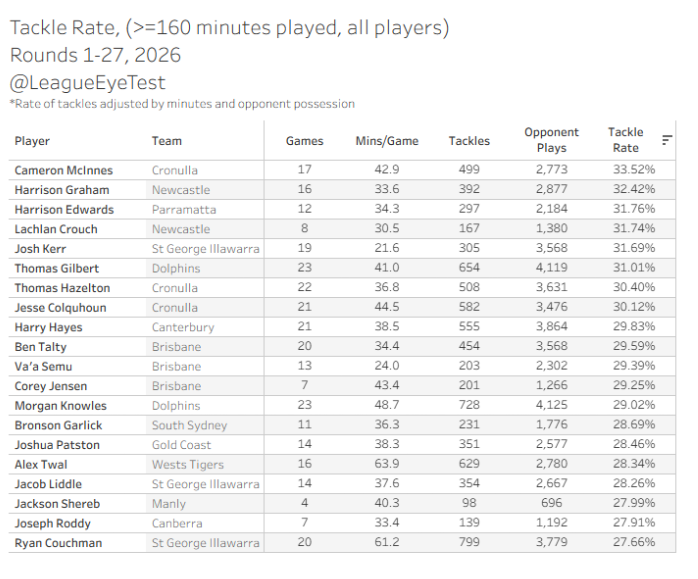
Roddy can cover backrow too, but his utility should be directed primarily at supporting Hosking in that role. He showed that he can already handle thirty minutes a game in NRL, and if he can Hosking could split those minutes at 13, it could play a big role in the addressing the problem.
Step Two: recruiting for type
But that’s only part of the solution. So far this offseason there has been a concerted focus by the club on fixing this. Malachi Smith’s elevation has been noteworthy; he’s a potential prototype for a utility/13 that can come in a tie-up the middle. In his one NRL game he made 19 tackles in 24 minutes. In NSW Cup he averaged 35 tackles a game. But there’s not the data, nor the tape, to tell us how he’ll pan out yet. Expecting him to be ready for round one 2027 is naievty that even a fan-blog like this can’t manage.
So far this offseason the recruitment has been targeted at fixing this issue. Lipoi Hopoi and Jaiyden Hunt have both been brought in to play as part of the middle rotation, being the defensive support that will allow Joey Taps, Ata Mariota, Vena Patuki-Case (and probably Josiah Pahulu) to run free. Hopoi averaged a tick under 30 tackles a game in NSW Cup in 2026. Outside of Horse, that’s more than any regular Raiders’ middle made in 2026.
Step three: Yardage backs
But this cannot just be a one side of the ball adjustment. Chucking in some tackling middles won’t be a solution in itself. Even if you hold the opposition in check, the Raiders still need to get up the other end. Fixing their outside back mix needs to be part of the response.
The most obvious part here is teaching Savelio Tamale to catch. We, like most Raiders fans, can see the obvious potential. Tamale is already an elite yardage back, but if he never solves the bomb-catching issue, he won’t be a regular first grader (if he does, he’ll be an Origin player).
Having his 165m per game on the field and half-dozen tackle breaks can make a huge difference from his replacement. He made literally two metres more per run than Jed Stuart, who also had the third most carries for less than seven metres in the side, and nearly two less runs per game for more than eight metres than any other outside back on the Milk.
Tamale’s success also reduces the pressure on Xavier Savage, who’s yardage game plateaued in 2026, with the additional pressure of being the primary yardage back early in sets. Matt Timoko and Simi Sasagi can help too, but it needs to start with the back three as they are the players back to return kicks. Allowing Sione Finau on the first grade field, instead of Jed Stuart, will also help.
The better these backs do, the less forwards have to retreat, and the less they need to run the ball. The less work they need to do in exit, the more energy they can put into pinning teams in their own twenty, and penetrating defenses themselves to set up space for the halves. It’s cyclical, it’s reinforcing, it’s the vibe of the thing.
This must be fixed before any other questions. Before we talk about which half in which spot. Before we talk about shape and structure against vibe or improvisation. Before we balance youth and experience and other recruiting problems. Finding a way to control the middle of the ground was Canberra’s biggest problem in 2026, and it needs solving.
The first step to addressing a problem is admitting you have it. Canberra have done that. Steps two and three await.
Sign up to the email below to get our thoughts in your inbox to get ready for 2027. Don’t hesitate to send us feedback (dan@sportress.org) or comment below if you think we are stupid. Or if we’re not.


Leave a Reply