
Miracles are not real. Heroes are just stories we tell about the past. The House always wins, because it always does.
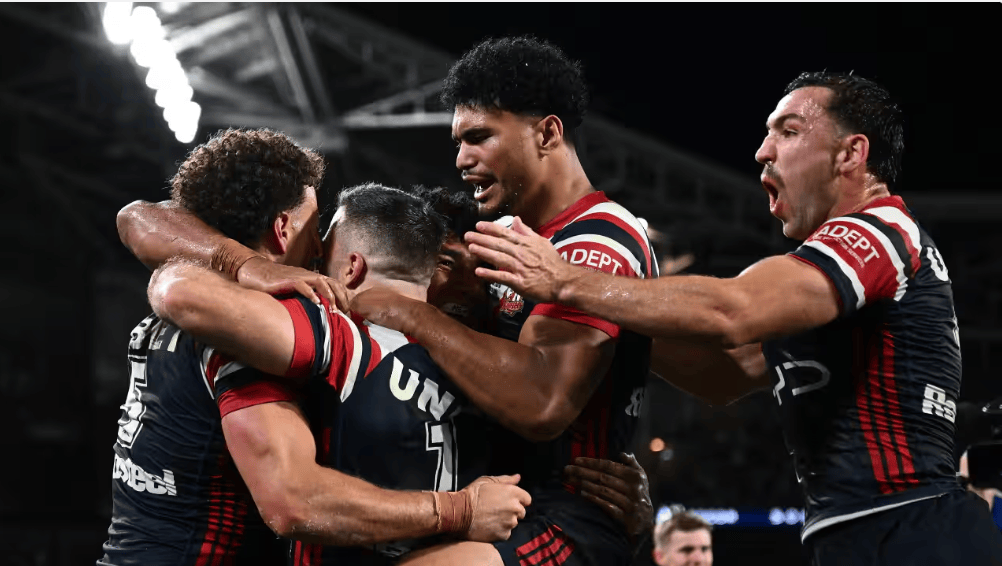
The Roosters 19-18 victory over the Knights was a quiet reminder that you can hope and try your hardest to prove yourself against challenges beyond measure. You can do everything and more and you’ll still be on your knees, alone in the spotlight, lamenting what could have been.
It was an impressive testament to the execution of professionalism overcoming the hope of the underdog. Weberian specialisation again proving more effective in result, if not in capturing hearts and minds. You can hold them out for waves and waves and waves. But eventually they’ll get it right. And they did, just enough. A whole season just to learn that life is hard and dreams are for suckers.
The game itself was not perfect, but it was exciting, and the closeness made it compelling if not consistent. It’s hard for a game to be highly skilled when one side has the ball, and the other is running on hope and chaos. In the end the precision of the Roosters beat the Cool Runnings of Newcastle. No matter the tornado of emotion and a flurry of activity, you can’t overcome a well-coached side with unending talent. Not without a miracle.
One: What is a miracle?
Is the miracle that they could have won? Or is that they were in the game at all? With about ten minutes to go the broadcast flashed up that the Roosters had gained 1800 metres to around 1000 for the Knights. 50 odd tackles in the opposition half for the Roosters to four (4) for the Novacastrians.
I’ll wait for the Rugby League Eye Test to tell me (oh look, he did) but I bet the expected score wouldn’t have been close. Those kinds of metre differences, those tackle differences, usually result in blowouts. But it didn’t. And when the Knights scored with minutes to go there was hope.
But that was this Newcastle team’s style. Rope-a-dope. Absorb the punches. Let the opposition tire themselves trying to run around their manic defence. Get the ball, shift, find a one-on-one and bet on Ponga, Best or someone to beat their man.
Every time they got the ball they tried to score. Most of the time it just resulted in them shifting side to side. If the Roosters 3 and 4 defenders (the backrower and the half) didn’t get caught up with line-runners inside the play, they were able to cover across, and the Knights got stuck going nowhere. So many sets ended either going out, or on the sideline. Most of the time the Knights just shrugged and spun the wheel again. But on their last set the side-to-side robbed them of a chance to work for a last tackle field goal.
It’s high variance football, even if it never really found its groove in the last few games of the season. As the teams got better, so did the defences, and suddenly the rugby league equivalent of just jacking threes didn’t have a lot to stand on, and the defensive fervour had to carry the day. It almost got them there.
Two: Enough perfect
To beat this the Roosters didn’t have to be perfect all the time, but everything had to go right to score. The critical try at the start of the second half to Billy Smith involved so many moments that things go wrong. A bobble. A held ball instead of a pass. Defenders desperately trying to close out, forlornly.
Getting around this Knights defence took everything going right, and even then it wasn’t enough. The other two tries, both to Mark Nawaqanitawase, required additional risky manoeuvres coming off. A flick pass, a cross field kick. A loose ball toed ahead. These things don’t normally work, and the Roosters don’t usually need them, but if you’re going to get through a defence playing with the ferocity of a convert, then it’s going to take something a little different.
That’s the test this Knights team presented. You didn’t beat them with the traditional ‘four up the guts, well worked shift to the centre/backrower who goes through the hole’. The holes didn’t exist, such was the intensity of the inside out cover. Similarly, in defence they just asked you to keep solving the same problem, punch after punch after punch, knowing that all it took was a slip up and they’d have their knockout.
It was a test of patience. Of confidence in your systems. In your ability to not panic when they threw yet another shift at you. Of your ability to not start trying to invent new ways of playing when yet another movement of your own was swallowed as a hole vanished like a universe collapsing on itself.
Three: Teddy and Naf
A good example of the Roosters willingness to make play after play no matter the questions asked was in the work of James Tedesco and Nah Whyte. Teddy won the Clive Churchill, and you can make the case on numbers alone. Nearly 400 metres on the ground with not many cheap metres on kick returns on break away tries. Just dirty work in yardage, patience chiming in attack. Hard work and harder runs.
Naf Whyte had near 200 metres on the ground and every time he had the ball it felt like a moment. On another day we would have marveled at his impact running the ball. A human momentum machine.
But both had more impact on the other side of the ball. Teddy wasn’t tested as much in defence, but when things got chaotic it always felt like he was landing on a loose ball, in the right spot for a hopeful kick, ready to clean up. Whyte did some of his best work there too. He is an elite middle defender, and played a big role in limiting the Knights sideways movement by collapsing the ball through the middle of the park.
Four: Fatigue
And of course, the fatigue played a role. As the game wore on too many Knights movements ended with a stone-cold drop from someone hoping to do better. The months of playing defence like they were carrying the rage virus caught up.
Even after they scored late, allowing themselves one last shot at the moon, the ball fell off hands when it didn’t need to. Jermain McKewan dropped the ball, Dane Gagai desperately put a toe to it. Teddy dived on it.
There they stood, exhausted and hopeless. Instead of Elysium they found tragedy.
Five: Redemption
Others found redemption. Daly Cherry-Evans missed a field goal in the opening round of the finals that would be a big part of the Roosters’ demise. It was uncharacteristic. The best game manager in the game was shuffling off the NRL’s radar. Would it be with a whimper?
In this game he slotted the game winner from a similar spot. He had ages, because the Knights were not really ready for it, because it was precautionary rather than necessary. But he was the one that identified the need, and executed the high percentage play. It ended up being the difference.
It was another example of the comprehensive performance of the Roosters. Winning took ticking all the boxes. The patience. The discipline. The commitment to winning over 80 minutes through concerted implementation of a game plan, collecting moments of brilliance rather than relying on them. A Roosters side that has felt enigmatic in the past became predictable, but not in the pejorative. Much has (rightly) been made of the Knights transformation this season. But at the back end of the year the Roosters found a resolve, and a control to their flamboyant artistry, that enabled them to win this game.
It was no miracle. And that’s why they won.
Six: Thank you
This is the end of the season for the Six, Again series, our weekly roundup of things going on around the league. This is undoubtedly the hardest thing that I do in these pages, and one that I value for it stretching my mind, my fingers, and my patience. I am grateful for every one of you that stuck around to read these.
Sign up to the email below to get our thoughts in your inbox for the vibes, the dreams, and the stories. Don’t hesitate to send us feedback (dan@sportress.org) or comment below if you think we are stupid. Or if we’re not.


Leave a comment