
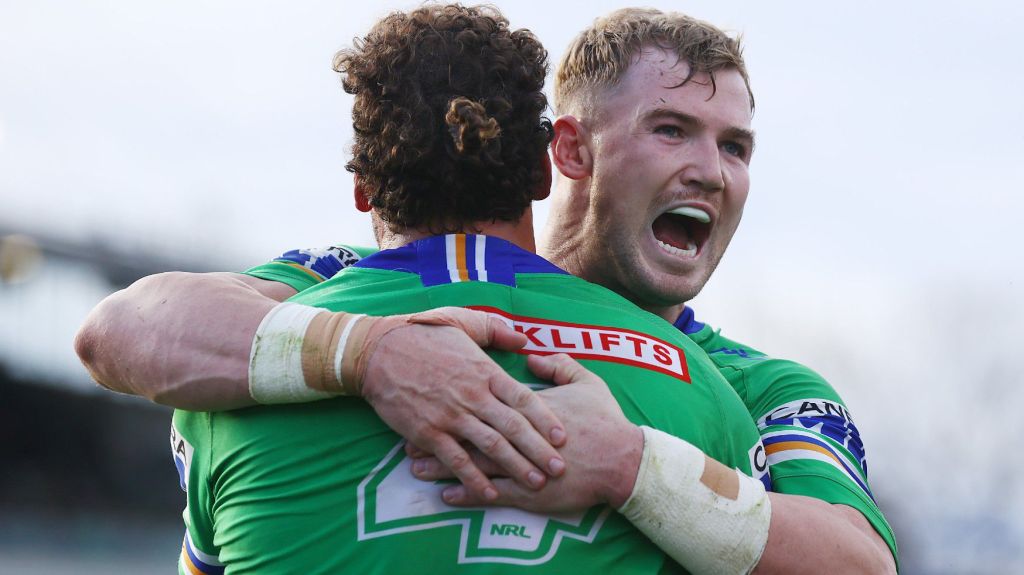
Hudson Young has gone to the player’s union asking them why the Raiders have increased his market value.
As Brent Read of CODE Sports reported, Young will go to the market to lower his value, presumably in order to allow him to take the Chief’s deal. He has spoken to the player’s union about his frustration. As Read said on NRL360:
I think he will go to market cause I don’t think he’s happy. He’s spoken to the player’s union about this. He’s been offered the opportunity to go to the NRL about this so he’s obviously not happy. You don’t go to the RLPA (Rugby League Players Association) if you’re happy
Huddo’s frustration comes from being correctly valued by the Raiders. The number is high, but the argument that $1.1m without ratchet clauses is not the market value for the best backrower in the competition doesn’t hold realistic water in a world when other rep players are seeking deals closer to $1.4m. But by going to market, there is an intent to get that value lowered closer to the Chiefs $900k offer.
This should be treated as the cynical exercise it is by the league. The cap exists to stop financially powerful teams from hoarding talent, and seeks to limit the impact of other factors (like living in Bondi, playing for teams with the best facilities etc, or access to third party deals), from creating a two-tier league (in theory). Instead these tax settings give the Chiefs the ability to get talent at substantially under market value.
This puts them in a position of power similar to those of the Broncos or the Roosters, who are able to leverage non-cap financial benefits (like third-party deals, or access to business networks). The only difference between the Chiefs and the Roosters is that we can quantify and see this.
There is likely nothing the union can do about it, either in support or against Young. They are beholden to the bargaining agreement, and it doesn’t cover the impact of federal tax settings. I would be surprised if a union was keen to go too hard on setting a precedent where they use their limited collective power to advocate for lower market rates for players. Besides, if Ayoub was actually acting in his client’s interests he’d be advocating for the Chiefs to pay his client the extra $50k. Tax free, of course.
This is a problem that Vlando has created. The cap, as messy and imperfect as it is, had been working. Penrith could have won the comp for a decade if they could have kept To’o, Crichton, Burton, Leniu, Leota, Koroisau, Hosking and Luai (well, maybe not Luai).
He’s not a smart man, so he didn’t realise the Chiefs comparative advantage could have been in third party deals. They’ve just signed the biggest sponsorship deal in rugby league history, and there are enough transnational corporations with interests in the market for rugby league superstars with unrivaled cultural cachet to make a motza out of it.
The tax settings give players additional certainty while also extending the incentive. But they also undermine the integrity of the cap system. If a team can sign million-dollar players for two-thirds the cost, they’ll by definition have more elite players than anyone else. The intent of market value is not about earnings; it’s about maintaining equalisation of talent across the competition. Without the NRL holding market value we’ll see a disruption to this process.
This has already had material impacts. Case in point. The Chiefs got Brian To’o on $600k per most reports and scuttlebutt. There at 17 teams across the league that would love To’o for 600k. But they know it would have taken much more to get him to the club – probably closer to $1m a year, which is broadly equivalent under an actual tax regime. If Vlando had shown the same interest in the cap when it had first become a problem, he still might be a Panther.
Unfortunately, it took until the Chiefs started punching down for the NRL to take notice. Canberra now has the opportunity to take action to keep talent they have identified, developed, and remained patient with. The big end of town loves to pick up other people’s surplus, but through regulation we can make sure resources stay more fairly distributed.
But this will require both the league holding the line, and the Chiefs not finding an extra $50k under the couch to elevate their $950k to the million the league thinks is the line. I suspect the latter will happen if the league doesn’t allow the deflation of Young’s value to bring him into Papua New Guinea’s preferred range. But the Chiefs would rather hold that money until they actually have to pay it.
But even if it won’t necessarily impact the outcome of the deal, the NRL should hold the line. Because if they don’t then the power spreads beyond just getting Hudson to go with their already highly paid outfit. And it renders the salary cap toothless.
Sign up to the email below to get our thoughts in your inbox get ready for next year when we win the comp. Don’t hesitate to send us feedback (dan@sportress.org) or comment below if you think we are stupid. Or if we’re not.


Leave a Reply