
BY DAN
Hello and welcome to our offseason series on the six big questions facing the Raiders in 2026. We’ll back with five other parts over the coming weeks.
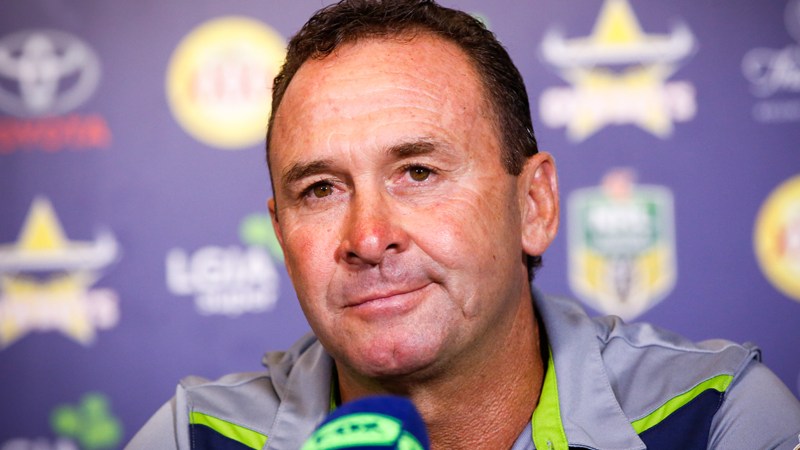
Ricky Stuart works in cycles.
In 2014 he stripped a roster of its deadwood, rebuilt it over 2015, and it thrived in 2016, unleashing an electric offense on a competition not ready for it.
In 2017 that team sputtered inefficiently, an array of defensive lapses, game management chaos and generally not living up to expectations. Any comeback in 2018 was derailed by Josh Hodgson’s knee injury (and Stick’s comical Aidan Sezer based solution).
That side peaked in 2019, and arguably into 2020. Then Covid came, and so did Vlando taking a giant dump in the middle of the party in the form of the set-restart rule, Canberra didn’t adjust and that team collapsed like a star on itself in 2021.
2022 and 2023 were spent trying to recapture the vibe which led to a forced sea-change over 2023 and 2024. Canberra’s round one 2024 starting 13 only had 3 people from 2022 (though Jordan Rapana and Jamal Fogarty missed the 2022 game and would have otherwise been included). A youth movement was adopted and adapted, some critical talent was brought in, and Canberra made another run in 2025. You’re familiar with how that ended. Let’s not dwell on it (today at least).
Stuart faces a challenge in 2026 that he has never quite mastered. How do you turn one up the ‘up’ cycles into a permanent trajectory? How to turn a wave into a tide? Canberra doesn’t have to win the 2026 minor premiership again, but how does he ensure what was achieved in 2025 becomes the range of normalcy, not the outlier that which we all fondly point to?
There are caveats. Firstly it’s important to remember that growth isn’t always visible, and it isn’t always linear. Canberra’s improvement in 2025 was shown not just in style, but in output and outcomes. They won the close games (until they didn’t). They performed exactly, or slightly above, their statistically-expected levels, and regression is always a breath away. Variation will come for them, and perhaps not in a good way. It’s entirely possible improvements can be made in 2026 that don’t show up in results in a way they did in 2025.
There is potential for improvements to be made ‘under the hood’ (as we wrote here), and not play out on the scoreboard. That’s only more complicated by the fact that development isn’t linear, and the potholes and pitfalls of learning can deliver benefits in other years. This is even more impactful on the Milk given the age profile of their squad. So many young players are in the space where the game takes notice, makes their job harder, and they have to find a new way to be brilliant. Sometimes a step sideways feels like one back.
This is compounded by the only significant roster change for the Raiders. Introducing one new player is usually a cause for celebration, a symbol of stability and cohesion in the roster. But given the weight of role of the departed Fogarty, and the inexperience of either Ethan Sanders, or Coby Black, this creates a substantial challenge for the club to adjust to. Fogarty was best when the ball was in his hands and team his to conduct.
It will be interesting to see how Stick manages this. Will he give the full scope of responsibility to the incoming half? Will he lean on his marginally more experienced incumbents like Strange and Weekes to drive the car? How will he ensure that either Sanders or Black, now in competition, will feel suitably secure in their role to tell more experienced players where to go or what to do? Will he lose patience, going back to experienced back-ups because they offer him greater certainty of output. It’s certainly something he’s done before with his preference to bring back Sam Willaims over developing Mitch Cornish, or play Aidan Sezer at nine instead of Craig Garvey, or Danny Levi ahead of anyone.
Just how committed is he to youth? Just how intent is he on development? How does one remain focused on the end goal when the expectations of success are so prominent. Building a winner culture or ensuring minutes and reps for young halves for benefits in future years? Having a clear idea of the end goal for 2026 will make these decisions easier (not that he’d necessarily share what is going on in that beautiful noggin of his). In the past it’s always felt like he’s chosen wins over everything. In a sense that’s his job. But with this bigger horizon afforded by the youth movement, does that change?
One arrow that Stick has in his quiver is the aforementioned stability and depth of this roster, and their expectation of success. The Raiders have at least 18 or 19 players that they’re trying to fit into 17 (or maybe 19, depending on whether the league changes the game-day roster mid-way through pre-season). At every position bar halfback they have a clear starter, a clear backup and depth coming through deeper down the roster. Despite the youth of the roster, only four players likely to start week one (Tamale, Sanders, Nicholson, Pattie) have played less than Ethan Strange’s 46 games, which is right on the precipice of Stick’s fifty game theory.
Captain Joe Tapine has been clear about that last year is just the beginning, the frustrating end should just be fuel for the dark days of the pre-season. The cold years that have followed the good ones would no doubt be on his mind, too. With Josh Papalii potentially (probably?) shuffling off the rugby league coil, there won’t be an issue with commitment to the cause. So while it’s a challenge, Stuart will have a sound base to work with.
But that doesn’t make the test any less grueling. Stuart, and his brains-trust, will have to achieve something that Stuart hasn’t managed consistently throughout his Raiders tenure: achieving consistent excellence. Breaking that cycle with a young, developing roster, a new halfback, and the eyes of the competition making sure there’s no easy victories may require Stuart’s best coaching effort yet.
The Sportress is transitioning away from Facebook and Twitter for distribution so sign up to the email below before we disappear from your feed altogether. Don’t hesitate to send us feedback (dan@sportress.org) or comment below if you think we are stupid. Or if we’re not.
 The Sportress