
BY DAN
The Canberra Raiders’ remarkable 2025 should not be assessed by their finals performance alone. The bitter disappointment of the last few weeks hangs over our eyes in the way that grief can. But when we emerge from the darkness we’ll realise that what they achieved this year should be celebrated, and should be a strong foundation for the future. The challenge will be not taking success as a given, and finding a way to evolve into 2026.
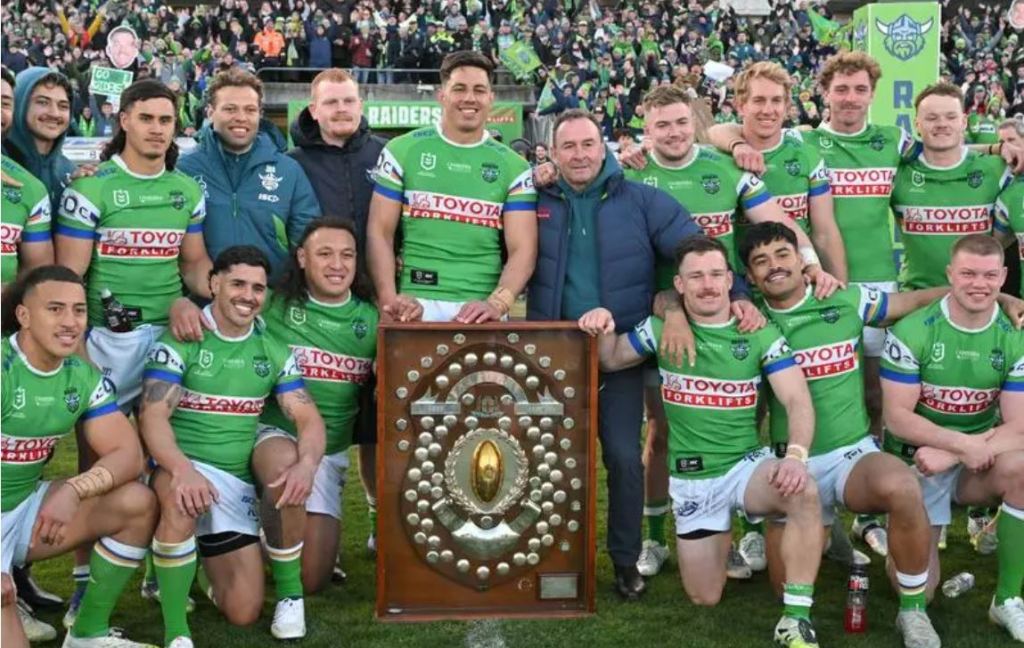
Right now it doesn’t feel great. The Raiders created a shining stand-alone opportunity but failed to take it, and in the process the achievement of creating it was forgotten. It’s worth considering in the scope of the season what they achieved. Coming into this season no one had the Raiders as a top four team, most didn’t have them as top eight. As many people had them coming last as any other position. That they turned that into their first minor premiership in 35 years is a matter for celebration.
What was most exciting was how sustainably built it was, taking their existing strengths and deploying them most effectively. Canberra played a high-pace attacking style, building through the power and offloads of their middle and utilising hard-run lines from edge forwards to wear out defences. Given a sniff of broken play they played exciting ad-lib footy. In red-zone sets they played precise and aggressive structured play, in particular using the space around Ethan Strange as a weapon that scared the living shit out of anyone trying to tackle them.
It led to nothing but good things. Fourth in points (thirty points short of first), third in tries (one behind first), fourth in line breaks, first in post contact metres, second in tackle breaks, first in offloads. It’s rare that the stats paint such a clear understanding of what made this team work, with the ball at least. This is a team that used its elite middles to kick the door in, either through post-contact metres or offloads, before hitting the edges for the payoff.
They tried to pair this with a defence that while quality, was held together with tape in some critical places. The right edge was a source of contention all year long. Shit it was a problem last year, and the year before, only obscured by the fact that the problem existed across the park. Fixing the leaks elsewhere just increased the pressure to the one spot and, well, Jamal Fogarty and Matt Timoko are just not a good pairing, like pickles and ice cream.
Combined with an approach to catching bombs that felt as stable as a three-day bender, and a middle that would sometimes lose the ability to run the show, it was a minor miracle that the Raiders turned this into an elite defence. If not for the round 27 calamity from the backups, this was a top four defence in points conceded. This should have been the basis of something greater than a two week sojourn into the finals.
But it wasn’t. And that should lead to three sets of questions.
The first is: was it sustainable? People will point to an 8-2 record in close games (fewer than six points), a league that took eight weeks to take them seriously. Wins against Cronulla, Melbourne and the Riff that could have gone the other way. Good teams win close games but variance is a funny thing. Next season they could find themselves with a field goal that hits the goal post and goes in and…I’m so sad. Even if they had lost all those close games against great teams, they were still a top four team. They could have beaten anyone that first week except the Broncos. And then what?
The second question follows: why did it then fall apart? Throughout the season the team had managed to overcome their weaknesses through energy and point scoring. Each game of the finals wore those two abilities to a nub, and exposed the weaknesses. In the Broncos game they dropped too much ball, put too much weight on their defence, and couldn’t hang on. In the Sharks game they couldn’t find a way to turn position and possession into points, and it meant their defence had to be perfect.
It wasn’t, and individual efforts couldn’t cover the gap. The weight of expectation, of the moment, proved too much. Key moments were missed in every game; as though they were trying to prove just how important finals experience was. It was both structural and individual, the socio-ecological model of football being demonstrated before our eyes. Problems at all levels obscuring a beautiful world, just out of reach.
The third question is: how to avoid that ever happening again? A key part is continuing to evolve their strengths. They cannot expect to simply run back the same plan and hope to succeed. As Stuart noted in the post-game of the season-ender, whether they like it or not, they are marked men.
Some players, like Tom Starling, Kaeo Weekes, and Corey Horsburgh had the kind of years that will be hard to replicate. Starling cannot be better, but he just has to be the same, for less time, as the job share with Owen Pattie changes its shape. Weekes won’t have as many moments in free space. But his timing and role within the offence will become more sophisticated as he does, and more practice under the high ball will get him closer to perfection. Horsburgh was at his best, but it’s an achievable best; what we’d all been expecting of him to put together consistently for years.
Thankfully there’s natural improvement elsewhere in the roster. The Sharks loss was a stark reminder of how important Ethan Strange already is. He’s nowhere near fully-formed, is likely moving to his preferred right hand side of the field next year, and is now getting close to the mythical 50 game mark whereby the game starts to slow down. He’ll be better next year.
They’ll also hopefully get more complete years from Matty Nicholson and Sav Tamale. Neither looked physically 100 per cent in the end of the season, and their abilities open up what the Raiders can do so dramatically. Owen Pattie has nothing but improvement in him, with a potential so limitless it could change the whole game. While Ata Mariota was excellent this year, he has more to give. Joe Tapine and Josh Papalii can’t be better, for varying reasons, but anything close to the same level will be enough.
More than individuals there’s an opportunity for greater cohesion to be built into this side. This team is together for the long term, and can build together if they don’t lose sight of the prize and instead get caught up in the frustration if 2026 doesn’t rise as smoothly as 2025 did.
It’s a long term plan though, because minor personnel change has a major effect. Ethan Sanders joining the first grade side will shift Ethan Strange to the other side. This will strengthen the right side defence on its own. This was a defensive relationship that had become untenable. Ethan Strange’s arrival will make that tenable (I only learned that was a word when it didn’t have a red-squiggly line under it). Matt Timoko’s spot in first grade, which currently feels undeservedly in-the-balance, will be stabilised too.
But fixing that problem will interrupt what had become a dangerous left side attack. This side had been Canberra’s best structure. The right side was predicated on hit the backrower or Kaeo Weekes and with notable exceptions (all involving Ethan Strange jumping to the other side) that was about it. The left was where Canberra actually could play a bit of intelligent footy. On the right Strange will have to build a new understanding with Kaeo Weekes. But the end product could be incredible. Imagine a defence having to decide between tackling the avalanche of Strange, Nicholson, Timoko, or the cobra lurking out the back.
It will take time, I think. 2025 was less a roller-coaster and more a steady ascension, only for the footing to slip just as the mountain peak was in sight. They have to start again, only now the conditions will be tougher. More will be expected from key players as Ethan Sanders takes the wheel from Jamal Fogarty. More will be thrown at them by oppositions that will treat them, initially at least, as minor premiers rather than the presumptive wooden-spooners. Even in the best case scenario the climb will be tougher in 2026.
But if 2025 ended poorly it shouldn’t obscure the fact that it was a massive success. Proof that the Raiders have put together a roster that can win the whole competition. That it has the depth, the athletic abilities at key positions, the philosophical courage of a premiership winning team. With the ability to build on those in 2026 and beyond they could be on the brink of something great.
So I know times feel dark. The wasted opportunity slipping through so fast that we didn’t really even get to see it coming. Saturday went from hope to anxiety to despair so fast that we’ve spent the next few days bargaining with death for another shot. One will hopefully come. Canberra have built the foundation for it.
Do us a solid and like our page on Facebook, follow us on Twitter, or share this on social media and we can cry together. Don’t hesitate to send us feedback (dan@sportress.org) or comment below if you think we are stupid. Or if we’re not.


Leave a Reply