
BY DAN
The NRL has a rule it needs to fix.
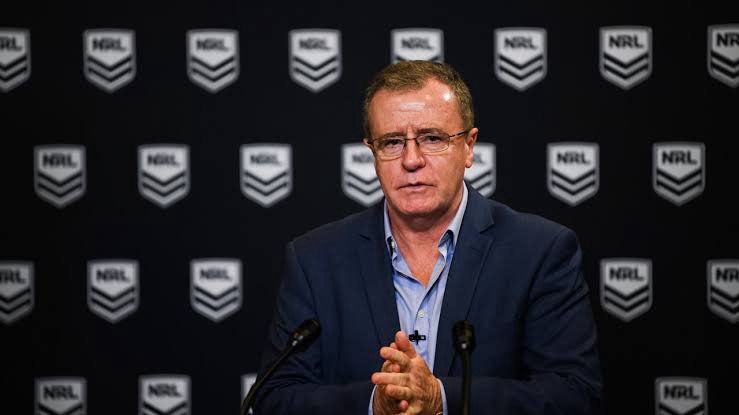
That’s the only possible assessment to take away from Graham Annesley’s support of a decision by referee Grant Atkins and bunker official Chris Butler on Saturday. By now you’ve probably either seen or heard about the issue. Brooks lifted Fogarty above the horizontal. Fogarty trying to protect himself on the fall dropped the ball. The referee said because he landed safely it was just a knock on.
Let’s start with the obvious caveats. In all likelihood the Canberra Raiders were going to lose before Jamal Fogarty was lifted into a potentially dangerous position by Luke Brooks on Saturday. The score was 28-12 and as we wrote in the review, the Raiders’ defence was being stretched and torn like a fat man in a little jacket (I miss you Chris Farley). Without knowing what Joe Tapine said to referee Grant Atkins we can’t comment on the appropriateness of an immediate sin-bin (normally players are marched ten for an immediate offence) but safe to say it was probably on Tapine to deal with the matter in a more level-headed manner. This was not a game defining decision.
But that’s not the problem. The issue is that the referee allowed a dangerous tackle to occur, and this was then supported by the bunker official. And by endorsing their decision on Saturday, the league has now confirmed the impetus on players to maintain their own safety rather than maintaining as safe an environment as possible. It’s an entire conga-line of confirmation that players can be lifted above the horizontal.
It’s important to remember rules around these sorts of tackles were put in place because of the substantial physical risk that comes from being put in the position. Players are helpless, at higher risk than normal, and at best are forced to choose between bracing and maintaining possession. That means the mere act of putting someone in a dangerous position has to be the prime concern. But according to the league the issue isn’t the tackle, but the outcome.
Let’s start with the letter of the law. As put by Annesley “above the horizontal” has nothing to do with. This is true. The ‘dangerous throw’ rule applied actually “in which the head or neck of the attacking player make forceful contact with the ground” (page 12 here). I would note that a standard direction under the judicial code is
it will be a dangerous throw if there is lifting of the tackled player so that he loses the capacity to protect himself by contact with the ground and may fall dangerously (page 98 here).
This quite clearly applies in the Fogarty tackle but that’s by-the-by. Like most NRL enforceable activities it isn’t about the letter but rather the interpretation of the law. As noted by the O.G’s over at the Greenhouse, the “above the horizontal” has been part of league interpretation for over ten years.
That is now changed. Instead the outcome, a safe landing engineered not be the tackler but the tackled, is the determining factor. In this circumstance Fogarty offered up possession to save himself. And because of this no infringement was recorded.
That’s a pretty dangerous change to interpretation. Outcome not process is a generally a terrible way to rule on things. In this case it’s even worse because the potential outcomes are so dramatic. Turning lifting tackles into a game of chicken in which the ball runner is choose between holding the ball and risking injury of the worst kind is a fascinating stance for a game to take.
There are causes for this. The obstinance is modus operandi for a league trying to retrofit a process to a flawed process. The referee on the ground got it wrong. His backup in the bunker did too. They did that because they’re humans. The Monday morning clean-up from Annesley is a staple of the genre.
There’s also the search for black and white. The rule says contact with the ground. That’s all there is to it, nothing can be done. This ignores ten years of precedent, or the fact they can just change the rules faster than I give up my seat for your mum. They did it with set restarts. What if we fucked around and made player safety a priority?
It’s also a function of a league captured by the talking heads of the Sydney media, on NRL360 and on Channel 9, who love to think that if no one gets hurt then play on. I wouldn’t look to them for risk management and rule-setting. Unfortunately the league does.
This would be ‘just’ a problem if it was something unequivocally dumb such as the six-again rule, or the seven tackle set. But this precedent, if continued, could revive something we had stamped out of the game, creating a massive risk to player safety.
Sometimes the cover up is worse than the crime. Acknowledging the mistake and moving on would have been the better solution. But now the league may have created a scenario where players have to maintain their own safety. It’s every man for themselves, and the league needs to fix it.
Do me a favour and like the page on Facebook, follow me on Twitter, or share this on social media and I’ll tell you the four words you need to know to be able to beatbox. Don’t hesitate to send us feedback (dan@sportress.org) or comment below if you think we are stupid. Or if we’re not.


Leave a Reply