

BY DAN
The Canberra Raiders don’t play the way others do.
In recent years the Milk have played in distinct opposition to the prevailing winds of rugby league. As teams have leaned into structure, Canberra have zagged, instead relying on winning individual matchups, breaking tackles, and winning with ferocity rather than shape. While Canberra’s play in 2025 was more complex than this binary, they are still a different beast than the other 16 teams.
Just how different? Well a recent piece by the always excellent Rugby League Eye Test provided some objective measurement of this. This is great because rugby league stats aren’t always excellent, but the work of the Eye Test is.
Before I go on, if you haven’t checked the article do so here. It’s a great look across the league at what goes into scoring a try. Here’s the link again. Bookmark the website. Read League Eye Test material because you want to have a well-rounded understanding of the most beautiful game on earth. Do it because you believe in independent media. Do it because your fed up with what the paid media puts out. Do it or I will come to your house and listen to your significant other’s deepest concerns in a way you’ve forgotten how to until we forge a relationship that makes you slightly uncomfortable in a way you can’t put your finger on.
Sorry, got carried away there for a second. Anyway, read the article.
A characterisation we’ve consistently talked about is how Canberra is less dependent on structure. NRL teams all play variations of a theme in structure, broadly working towards a shift or two a set whereby they put key ballplayers in a position to make a choice from a decision-tree based on testing the decision making of edge defenders.
There are variations to this of course, both between teams and within games, but you can call this the base attack of all teams. This is quite similar to the NBA in this sense; a recognition there are certain sets or ways of playing that work against professional defences, and teams gravitate to using these.
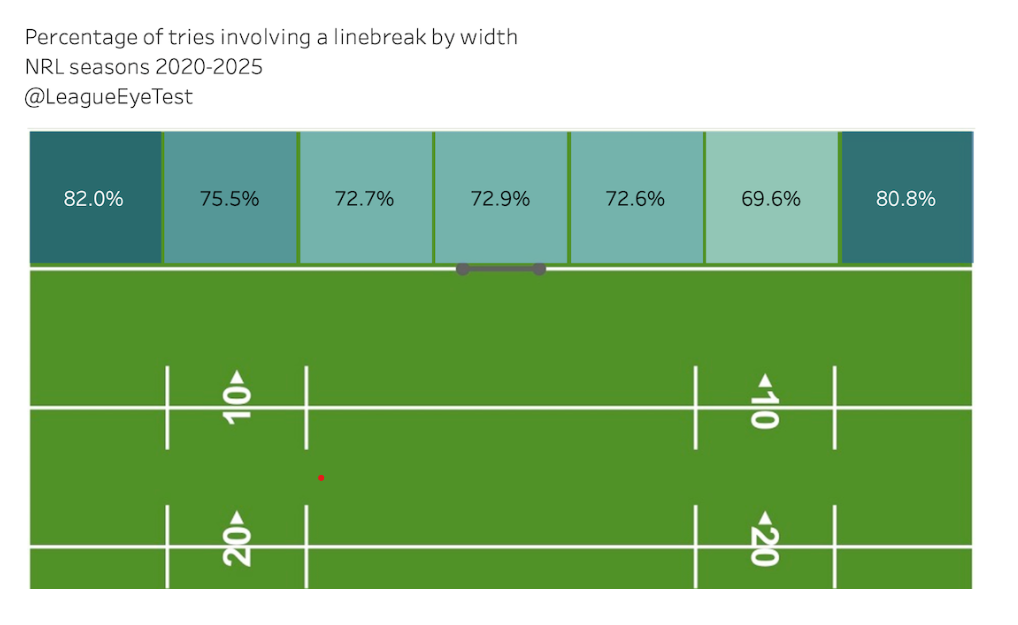
Canberra do too – just with a difference of emphasis. Most teams run these structures in order to engage the line, forcing internal defenders to hold in the middle, before spreading the ball wider to hopefully find a line break. This is demonstrated by the League Eye Test’s graphic below which shows how the likelihood of a try including a line break increases the wider the ball gets.
Canberra, however, have notoriously low line engagements. In 2025 Jamal Fogarty led the team with 272, good for 8th in the league. But Corey Horsburgh was the next most, with 64 (it’s about 67th in the league – the Code Stats unhelpfully don’t list the number so I had to count. A man only has so many fingers and toes). This low level of line engagement is reflected in how often they engaged the line on scoring plays.
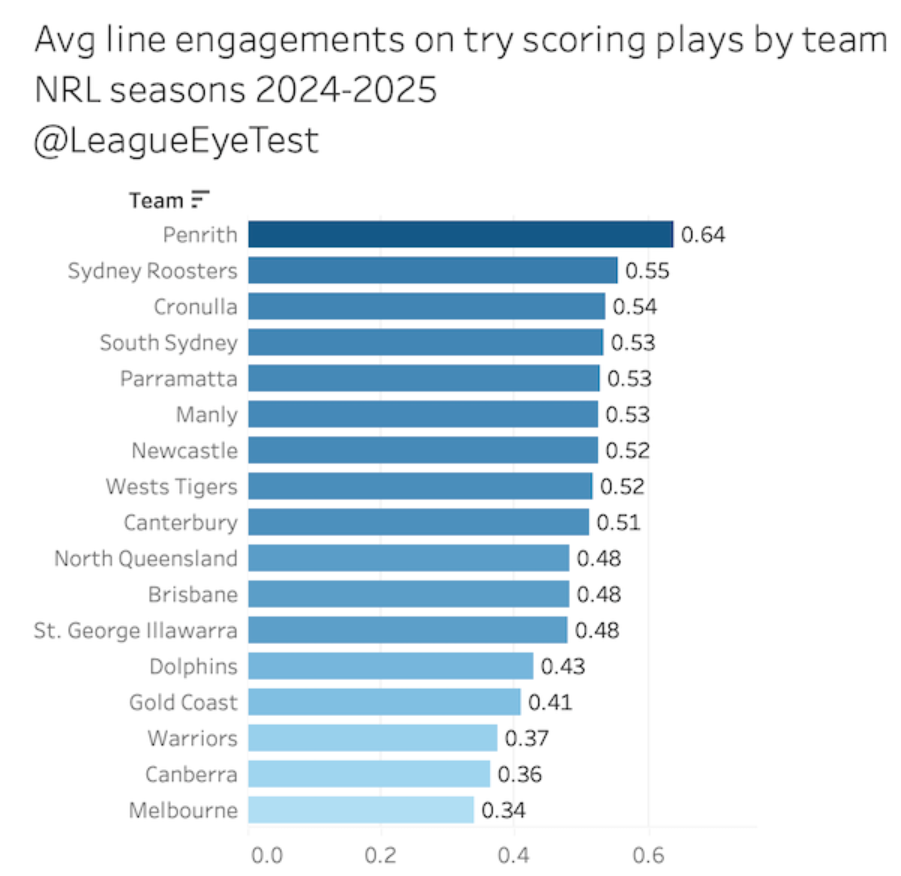
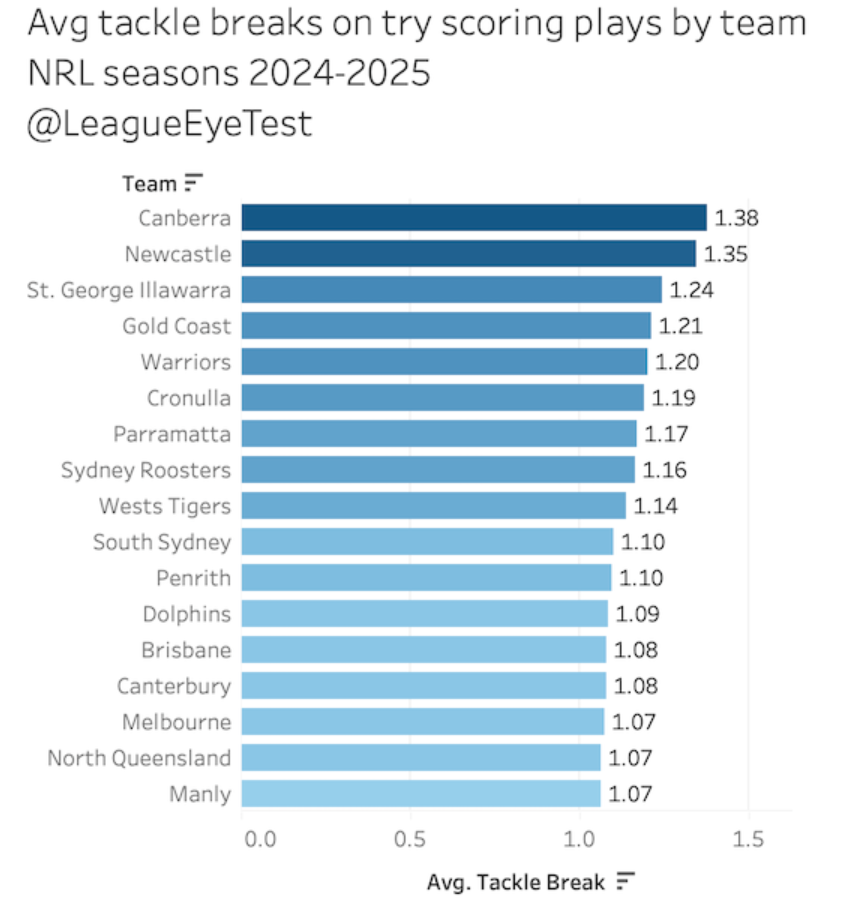
That lack of line engagement reflects Canberra both at their best and worst. At their best they are running with brutal, direct pace. Rather than halves digging into the line in order to create space for others, the ball is getting to their hard-runners on the edges who are trying to turn one-on-one matchups into tackle breaks, line breaks, and then tries. This is reflected in the number of tackle breaks they average per try.
Canberra also have the second fewest passes per try (1.97 – Brisbane had the fewest at 1.93, and Manly, playing shape to Tommy T, Saab, and Koula out wide, have the most at 2.66). This is further evidence for our characterisation. Less passes, less structure, more dependency on getting the ball to a ball-runner and letting them cook the man opposite.
The Raiders’ backline is replete with players that can beat their man one-on-one. Savage and Weekes do it with pace. Kris, Timoko, Strange and Tamale do it with power. Weekes, Timoko, and Tamale were 7th, 10th, and 14th in the league in tackle breaks respectively, and Tamale would have been numero uno if not for his injury. Ethan Strange had by far and away the most tackle breaks out of any regular five-eighth (100, Cam Munster was second with 86). Shit Hudson Young had the most tackle breaks for second rower. Tom Starling was second among hookers.
It’s hard to tell how sustainable this approach is. It relies on athletes being elite, and while that’s the case right now, in a league with a production line of brilliant performers, it can make an attack one dimensional. In the past this approach has meant they’re brilliant in open field, but struggle in the closer quarters of red zone attack. As the League Eye Test’s numbers show, that’s led to a greater proportion of their tries coming from outside of the redzone.
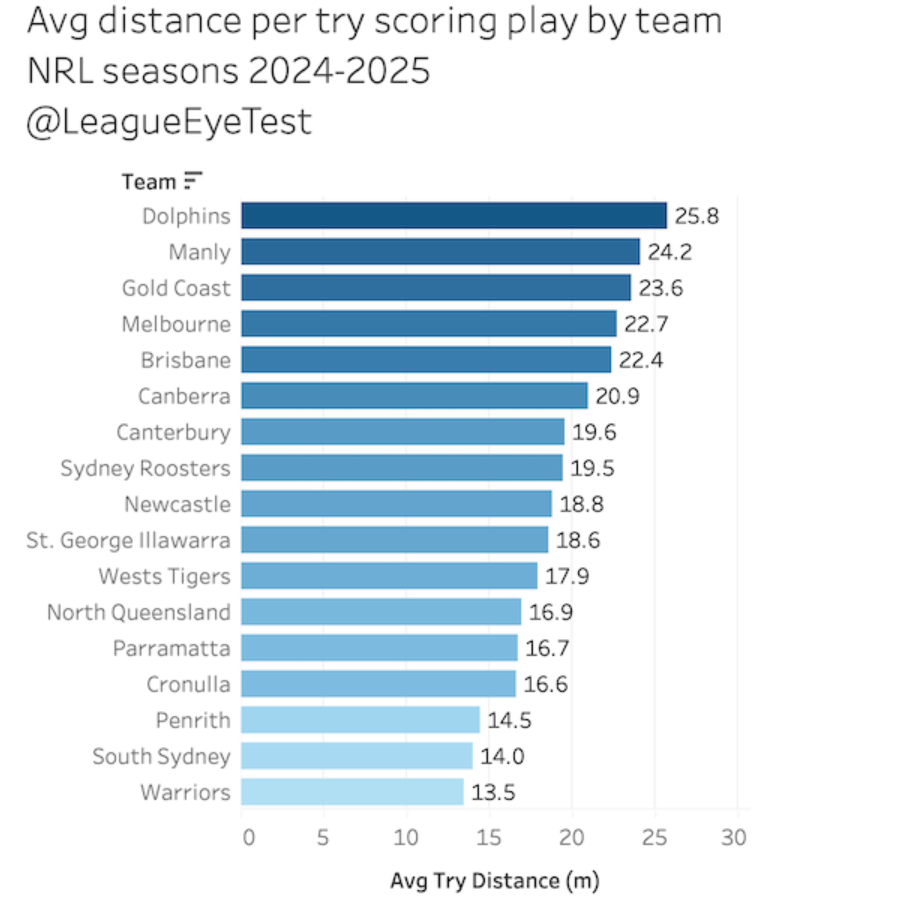
That average starting point of 20.9 metres puts it in the same stratosphere as the amazing offences from ‘Phins, the Storm and the Broncos, but over the 2024 and 2025 seasons its led to a difference in volume of occurrence. Canberra scored plenty of tries from long distance in 2025. In 2024 it was more of a reflection of how hard they found it to score. Too often their best option close to the line was Jamal Fogarty’s boot, and that came with variance.
Perhaps this is why Canberra continue to evolve. As we noted regularly last year, Canberra brought noticeably more structure to their play in 2025, and they found redzone attacking more fruitful. Ethan Strange got more experience as a ball player, becoming more comfortable digging into the line. Canbera were more deliberate and effective building sweep movements that resulted in putting players like Strange and Kaeo Weekes in positions to make run-pass decisions that other teams thrive on.
This was driven by Justin Giteau, who’s mantra as offensive mastermind has been focused around structuring the attack to player strengths. With Ethan Sanders coming into the line-up for 2026 we’ll be interested to see if that continues the evolution to more structured play, or leans ‘back’ to simplify the game for the young half. I lean to the former – Sanders seemed to thrive in structured play in Cup, particularly when he was at the helm of it – but time will tell.
But even if they do, they’re comparative advantage will remain in the more ‘eyes up’ way they attack the defensive line, and that shouldn’t be shirked. Players like Weekes, Strange, Timoko and Young are all better with early ball and someone to clown. Continuing to evolve will make their attack better and more sustainable in the coming years. But they’ll always be a little different.
The Sportress is transitioning away from Facebook and Twitter for distribution so sign up to the email below before we disappear from your feed altogether. Don’t hesitate to send us feedback (dan@sportress.org) or comment below if you think we are stupid. Or if we’re not.
 The Sportress