
BY DAN
The end was as confusing as so much of the season.
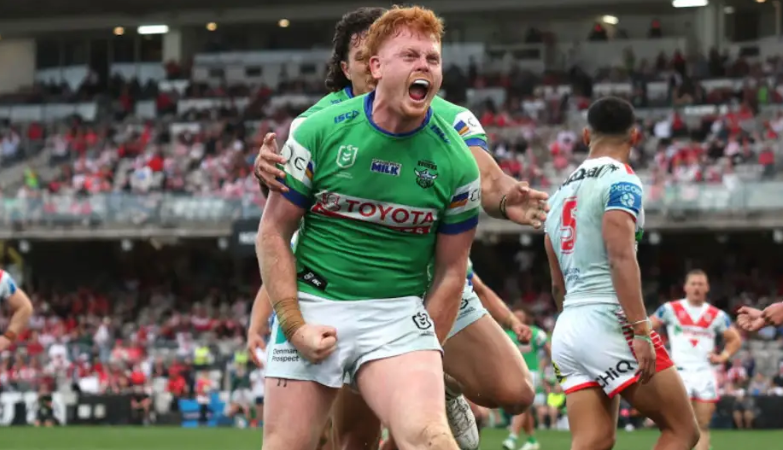
Jamal Fogary’s decision to ‘run it’ on the last was questionable. Passing it Corey Horsburgh was ever weirder. What was he even doing on the right edge? Why did Jamal trust him with what would likely be the last red-zone tackle the club would have for the game, for the fucking season? Then Corey kicked it, and a thousand green-eyed jaws dropped. It ended in his hands, he scored and Canberra won. 26-24 was the final score but given the season and the for-and-against that doesn’t really matter.
That moment, like the game, like the season, was a wave of furious emotion. After two weeks where there was nothing but effort they played the first forty minutes with all the resolve of an ice cream in the Sydney sun. Their defence, previously dogged and brutal, was suddenly welcoming, as though the players had been at the pub and been surprised they had to turn up for a game. They barely held the ball, they barely made a smart play. It was a familiar hell; the torment of a familiar foe. It’s not so much the pain of the experience, but the dread of knowing that despite the passing of time this is still your problem.
Through that period Canberra allowed some of the most heinous tries they’ve facilitated this year. People might want to talk about Albert Hopoate’s lack of interest in Zac Lomax outmarking him for the first try, but we could equally ask why the defence felt it necessarily to allow St George to march sixty easy metres down the field to make the attacking kick possible. On the first set. My god.
There was a theme here. The first try was poor middle defence and poor kick defusal. The second was just poor middle defence, with a quick ruck becoming a try because Danny Levi wasn’t strong enough by himself, and Hudson Young, Kaeo Weekes and maybe even Ethan Strange didn’t help well, or quick, enough. A third took the theme and expanded it, poor middle defence from Morgan Smithies and Joe Tapine giving Liddle a free run for 50 odd metres, then a grubber behind the line was met with ambivalence because the fullback was on the other side of the field, having had to clean up the break. The fourth added a little bit of variety to proceedings by mostly being about atrocious kick defence, involving not one but two kicks Canberra failed to clean up, due to what I’d describe as either a general ambivalence or perhaps a lack of knowledge that if the opposition has the ball they can, in fact, score.
I want to say this was indicative of something, some structural flaw. And sure that had its parts. Morgan Smithies and Danny Levi both got found out in defence too much through this period, but their errors were compounded because Taps and Huddo made their own mistakes. The Raiders middle defence can be oddly pleasant, not by design though (as Josh Papalii showed with his brutal hits in the first part of the second half). They’ve shown in recent weeks when they’re up for it they can defend better than this. They just weren’t up to it. Not initially anyway.
They certainly didn’t help themselves. By the time the Dragons had four tries on the board the Raiders had only completed three sets. One of those had resulted in a try. Their opposition had completed 12 of their 13 sets, outgained them by nearly double the metres, and were finding life pretty cruisy. When the Milk did get their hands on the rock they scored two very soft tries, and you might be tempted to take that as an indicator for what followed, but pretending there is any linear trajectory for the behaviour of Canberra (or the Dragons for that matter) makes you just as insane as the team.
Eventually the Raiders stiffened. Tommy Starling coming on to stiffen the middle defence helped, as did Josh Papalii. Corey Horsburgh and Tapine were locked in through the last rotation of the game. Something approaching what we’d seen in the last two weeks emerged. The Dragons game plan to roll over the Milk, both through the middle and by targeting big bodies at the smaller ones on the edge was met with some mettle. Breaks were still made, though always cleaned up (with the help of Tyrell Sloane). Everyone was doing their job and the Dragons were effectively reduced to bomb at Joel Monaghan Zac Lomax and hope.
It meant that the last 40-50 minutes of the game felt more like a question of whether the Raiders could find a way to get to more than 24 points. Canberra’s defence has returned to something to be pleased about in recent weeks, but the attack has yet to find anything useful, fluid or expansive. They can grind for sure. Joe Tapine (11 for 130m, 48 post contact, 3 tackle busts), Josh Papalii (12 for 127m, 44 post contact) and Hudson Young (17 for 211, 65 post contact, 6 tackle busts, two line breaks) were all excellent in their work. And the back five did their job, particularly Matt Timoko (15 for 195m) who seemed back for every yardage set. That’s what they did for much of the second half. Win the battle, kick to the corners. They definitely and defiantly did that.
The point of that plan is to get good field position to throw some bones. But after all this they remain incapable of risking it, despite the incentive of getting the biscuit. So instead we got much of what we’re used to. An attack as myopic as a horse prepped for whatever it is they put blinkers on horses for (I grew up in the ‘burbs’ don’t ask me. I’ve been on a horse once in my life). Multiple attacking sets were wasted without the ball getting a pass wide of the ruck. Not on some crash ball shit but more through constant set up rucks that never led to anything else. Some football version of purgatory where every play promises something to come down the line, only there’s no pass, no release, no excitement.
At the risk of telling you something you’re already aware of, this is part strategy and part personnel. The Raiders undoubtedly are keen to earn the right to spread it – Coach Stuart apparently told them team as much at halftime. But also they constantly miss chances to do so when they have earned it. On multiple occasions Levi took quick rucks as an opportunity to run the ball rather than get it in the hands of the creators. Given all of their tries had genesis in Jamal Fogarty’s decision-making this felt like a flaw. Smithies’ slow hands through the middle also meant that the ball didn’t get wide before he had to tuck and run. Indeed for the break that led to their first try Smithies either held the ball perfectly, or only just had enough time to get his pass of to Corey Horsburgh, depending on how you feel about him. Red turned the ball around much quicker and Huddo poured through a hole like a geyser.
The plan and the people mean that they rely overwhelmingly on second-phase play to create width. And beyond that their major attacking option was trying to hit Hudson Young on short face-balls and hope he’d be able to a) catch it in close contact and b) find a gap in the same. He made two breaks that resulted in two tries, one for him in an outside-in line so beautiful John Keats is still banging on about it. But other times he couldn’t catch it, and you can decide whether to blame overzealous passing or poor hands. It might be the only new string added to Canberra’s attacking bow this year outside of Fog’s massive leg.
Other players had moments. Seb Kris set up a try with a beautiful in-and-away. It was nice to see Timoko show the quick hands we know he has. But as pointed out earlier these were born from the rare occasions that Fogarty was able to play with width and space. The major downside was Ethan Strange had a quiet, though not poor game. To my untrained eye he seems to be stuck between playing to the corner and the goal posts. Straightening on the perpendicular between the two will open up his ball play and options for those around him. That’ll come – it’s a minor adjustment – but it makes the decision to rob him of chances to learn this year confusing. That is made doubly frustrating by how influential Jamal Fogarty was on the successful moments of attack. Again, he thrives as the key creator. He should have been left to do that all year.
The last forty of this game made the first 30 confounding, much like the peaks and troughs of Canberra’s year have perplexed. But like my dog Hansel once said, the results are in amigo, what’s left the ponder? The infuriating way that the Milk play requires them to max out all their effort areas to succeed. They’ve done that a heap recently, and it’s made them win games they normally wouldn’t. They didn’t for a bit in this game and they were suddenly losing to a deeply unserious football team. The best teams don’t have this variability in their games. They turn up all the time. It doesn’t need to be coaxed out of them.
But they also cushion that variability by creating more than Canberra. Even in this fun back end of the season the Raiders have been held back by what they’ve not been able to create on one side of the ball. LIke a car with a dodgy clutch, even when they’re revving hard it doesn’t mean they’re going anywhere. A problem for next year is utilising the talent the club has to do something other than hammer rocks like they’re searching for deliverance.
This is the end of it all, so let’s not get too pedantic. Instead let’s celebrate. A team that was too imperfect to make anything easy. A team too stupid to know better, content to wrestle monsters with their bare hands because no one’s told them about weaponry. A team that could rail against the dying of the light, even if it was them that forgot to change the lightbulb. They are the kings of a world in which there is no reason, nor order, and no sane person wants to be. This is the 2024 Canberra Raiders.
Thanks for all the love about our milestone. If you haven’t already like the page on Facebook, follow me, Rob, or Viv on Twitter, or share this on social media and I walk into hell with you. Don’t hesitate to send us feedback (dan@sportress.org) or comment below if you think we are stupid. Or if we’re not. Feature image courtesy of Getty.
 The Sportress