
BY DAN
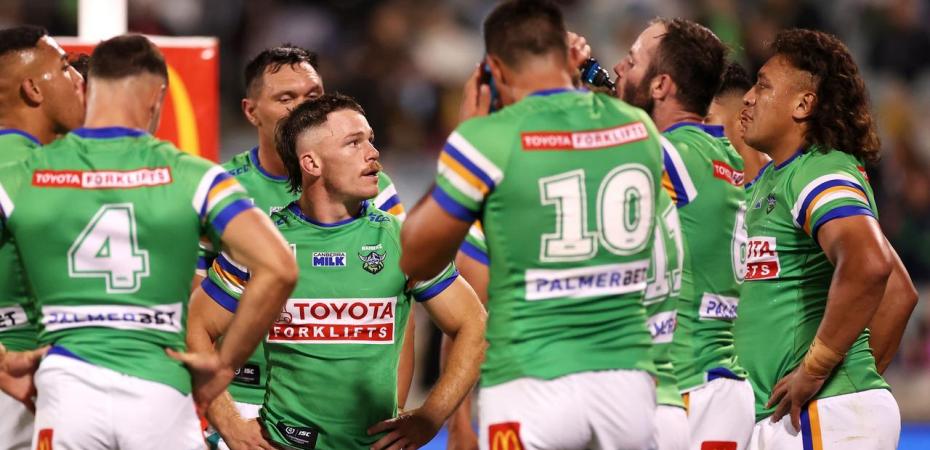
On Friday a good football team exposed the Canberra Raiders. In a game where there was no question of effort, the smarter, better organised Warriors held out when Papalii and Tapine were in charge. Then when position and possession flipped they targeted Canberra’s weak points with the precision of of a Jarrod Croker conversion.
It highlighted a problem Canberra have faced. Winning for them is never easy, and losing seems to take on a problematic tinge. Their for-and-against differential of minus seventy-odd comes from winning games by a very small amount, and losing them (admittedly less frequently) by substantial amounts. They are 6-3 over their last nine games. That’s really good. Those three losses were by 41, 28, and 22 points. That’s bad. None of their six wins was by more than eight points.
It’s like the Raiders have a ceiling on their performance, some sort of artificial barrier to their relative competitiveness. Their best can squeak by just about anyone – as they demonstrated beating the second, fourth and fifth best teams this year. But anything less than that results in the cold despair I felt sitting at Bruce Stadium last Friday night (there’s nothing like a Friday night at Bruce to be reminded how the Canberra air chills you inside out). Fixing this is obviously a good and necessary idea. Hoping to red-line your way to success is an hopeful as it is inefficient.
But what is the cause of this hobbit-style ceiling? As noted in these pages before the causes of the Raiders present situation are complex and variable. They’re relied on middle dominance for a period to establish a platform from which they could play more expansive footy. In the last two weeks though they’ve been met with packs that they couldn’t dominate. It’s not like they were over-powered, rather they couldn’t smash their opposition to pieces, and the rest of the team couldn’t adjust.
With Corey Horsburgh playing on an edge recently more pressure (and minutes) are being put into the legs of Joe Tapine and Josh Papalii. For example, prior to the last four weeks Joey Taps had one game where he played over 55 minutes this season. In the last four weeks he’s played 58, 68, 72 and 62 minutes. Papalii’s minutes have been more constant, but the pressure of covering Horse’s carries (as well as the reduced variability of removing that passing threat from the middle) have taken their toll.
While Papa and Taps have continued to perform with the ball it’s hard not to notice that it’s weakened their ability in defence. In the last two weeks multiple tries have been scored around the ruck, such as John Bateman and Wade Egan reaching paydirt from dummy-half through imperfect contact from the two stars. Other tries have been scored because these middles haven’t had the energy to effectively help inside out on opposition halves.
It’s not a matter of laziness. There work in attack is proof positive of that. They’re doing everything they literally can to win the Raiders footy games. On one try on Friday Tapine chased the Luke Metcalfe break like his life depended on it, was in the vicinity when that tackle was made, and then back in position to hopefully make the next one. The effort he made to chase down a back, and then get back into position was nearly enough.
This reliance on minutes for Taps and Papa is driven by Horsbrugh being on the edge. He’s been playing 60 plus minutes whenever he plays in the middle. Missing that has had a range of effects. Firstly it means that Tapine and Papa are relied on for more impact and more aggregate minutes. Secondly it means that when they’re off the field there’s a more noticeably drop-off. Instead of Horsburgh supporting the rotation forwards, pressure is put on the bench unit to have the impact without his help. This is compounded by what seems like a lack of trust by Stuart in those forwards. It’s understandable when a game is in the balance he wants his best players on the field, but there’s got to be a longer game here too. Carrying Nic Cotric on the bench has proven a masterstroke in the last few games, but it too compounds the cost here.
This relative dampening of defensive impact through exhaustion has impacts elsewhere. Canberra’s edge defence is already weak. Matt Timoko is still learning his trade, Elliott Whitehead and Jarrod Croker are both rageing against the dying of the light. It’s a piecemeal solution this year as the club transitions between eras and is far from perfect. For it to work it needs support from the inside defenders removing time and space for opposition ball-players, and covering for attackers heading against the grain. This puts even more pressure on an already exhausted middle.
The sum of this is the worst defence in the league – in both total points and average points conceded. The defensive issues mean that seemingly no matter what the Raiders are constantly on an uphill battle to outscore their opponents. The pressure that puts on the attack to not suffer periods of inefficiency is substantial, and when they don’t rack up points life becomes difficult.
The problem is that on that side of the ball the Raiders can also be limited. As witnessed last Friday the had plenty of good ball but weren’t able to do much with it (though they didn’t appear *that* far off). Early in the year they were stuck around the ruck, unwilling or unable to test the edges of their opposition. Great improvements were made to make their shifting movements more effective, but in recent weeks they’ve looked less effective. The shape of the attack has become rote and unremarkable as neither half, but particularly Jack Wighton, have been unable to straighten to attack at the edges at all. It’s like Hudson Young running those unfed lines for New South Wales, except as an entire attack.
The causes of this are many. Exhausted or outmatched middles don’t kick in the door as much, meaning the ABC defenders are better placed to put pressure on ball-players close to the ruck. This is likely compounded by ineffective service from the ruck (Hi Tom). The excitement of being able to run slick shifting movements (like they have since the bye) have perhaps led to an over-reliance on them to create overlaps or space. Jack Wighton is a complex dude and better when he’s not trying to do it all himself. Jamal Fogarty is worse when he’s playing second fiddle. Matt Timoko can’t run through everyone if he can’t get his hands on the ball.
The good news is that the fixes to many of these issues start with a more robust middle rotation. As long as Horsburgh is available to play middle minutes instead of on an edge, and with more trust by Stuart of his rotation forwards (and perhaps Mariota instead of Cotric on the bench) a lot can be done to ease the pressure on his star forwards. This could also play a role in freeing up some space to straighten the attack. That doesn’t solve all the issues (it seems that there’s no ready solution to the edge defence, at least this year) but will play a role in mitigating many of them.
A bye will also help. The tired middles need rest. The Raiders need time to tinker, both with edge defence and aspects of their attack. Last bye period they revitalised a moribund attack. Perhaps this mini-break will give them the time and space to fix these issues. And hopefully that will raise their ceiling a bit.
Do me a favour and like the page on Facebook, follow me on Twitter, or share this on social media because it’s the virtual equivalent of the ‘raising the roof’ dance and we need that right now. Don’t hesitate to send us feedback (dan@sportress.org) or comment below if you think we are stupid. Or if we’re not.
 The Sportress